
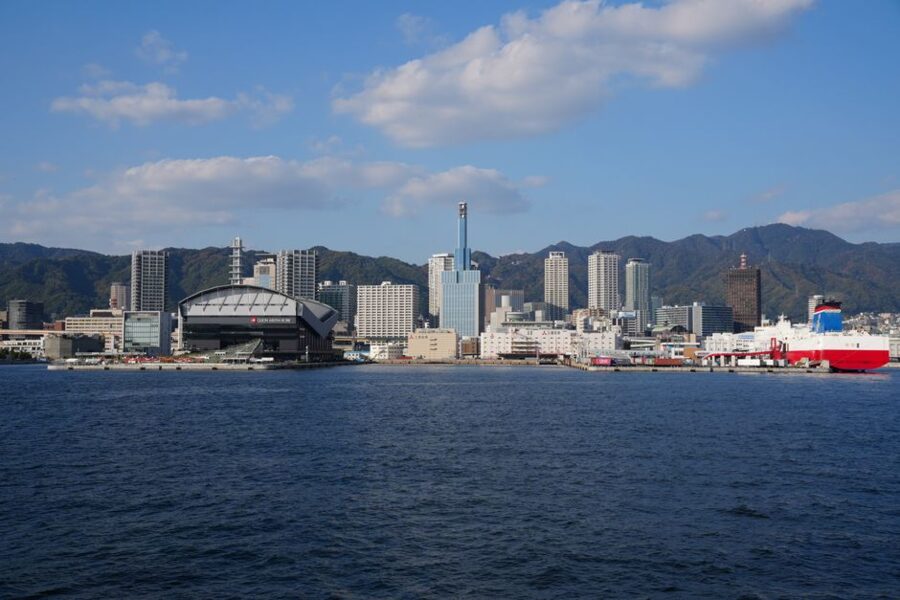
Hyogo Prefecture (兵庫県) runs all the way across Honshu, from the Seto Inland Sea in the south to the Sea of Japan in the north, and the limited express from Kobe takes two and a half hours to cross it. At the southern end is a port city of 1.5 million people pressed between mountains and water. At the northern end is a hot spring town of willows and wooden bathhouses where the crab boats come in all winter.
Between the two ends lies most of what people come to Kyoto and Osaka hoping to find and often run out of time for: the best-preserved castle in Japan at Himeji, a ruined mountain fortress that floats above the autumn fog, one of Japan’s three oldest hot springs at Arima, and an island that Japanese myth calls the first land ever made. Most people see one or two of them, on day trips.

I would give Hyogo five days: two nights in Kobe with an evening at Arima, a day for Himeji, a night at Kinosaki Onsen, and an early morning at the Takeda Castle ruins on the way between them. Awaji Island adds a sixth day if you have a car. Here is how the prefecture fits together, what each part is like, and what it costs as of November 2026.
Contents
The shape of Hyogo Prefecture
Hyogo covers about 8,400 square kilometres, the largest prefecture in Kansai, and had 5,323,825 residents at the October 2025 census by the prefecture’s own early count. Kobe alone holds almost 1.5 million of them. Most of the rest live along the Inland Sea shore, in a near-continuous belt of towns that runs west from the Osaka border through Amagasaki, Nishinomiya, Kobe, Akashi and on to Himeji.
North of that belt the ground rises into the Chugoku mountains, low but continuous, and the population thins out fast. The prefecture was stitched together in the 1870s from five old provinces, and the names still describe the country: Settsu and Harima on the southern plain, Tamba in the eastern hills, Tajima across the mountains on the Sea of Japan, and the island of Awaji in the Inland Sea.
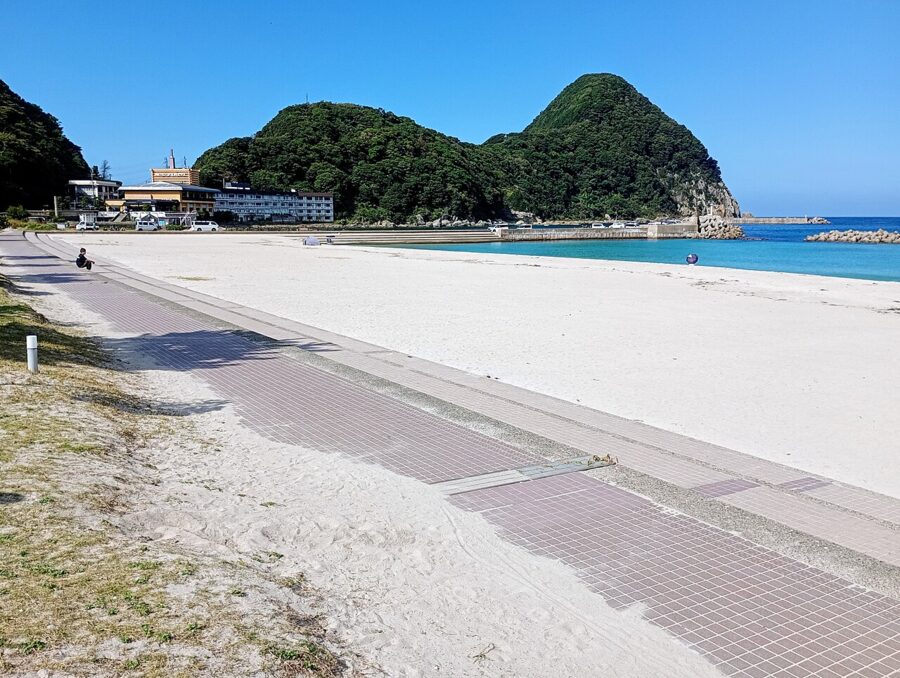

The two coasts feel like different countries. The south is warm, dry and industrial; Tajima in the north gets heavy winter snow and lives on fishing, rice and the onsen trade. The JR lines between them follow river valleys through the mountains, and that is why any trip north takes longer than the map suggests.
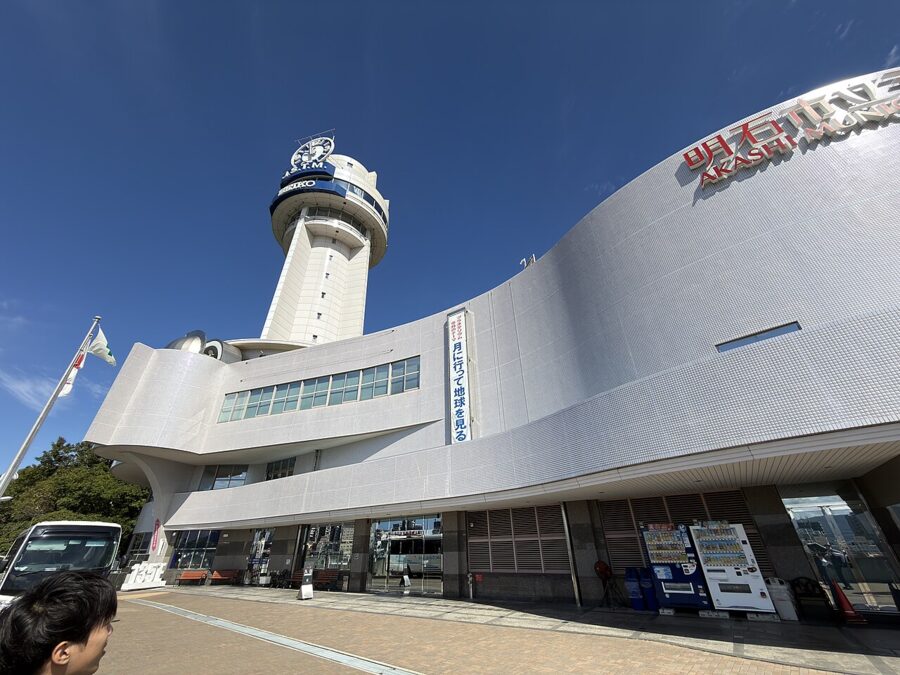
One more line runs through the prefecture, invisible this time. The 135th meridian east, the line that sets Japan Standard Time, crosses the coast at Akashi, just west of Kobe, and the city built its planetarium on it.
Kobe: the port that made Hyogo
Kobe was a fishing and trading village beside the older port of Hyogo until the shogunate opened it to foreign ships on 1 January 1868. Merchants from Britain, Germany, the United States and China arrived within a few years, and the city grew into one of the busiest ports in Asia. That outward-looking history still shows in the city’s bakeries, coffee houses and old foreign quarter.
The city is narrow and easy to walk. From Sannomiya, the main station area, the harbour is fifteen minutes south on foot, Kitano fifteen minutes north and uphill, and Nankinmachi ten minutes west.
The harbour and Meriken Park
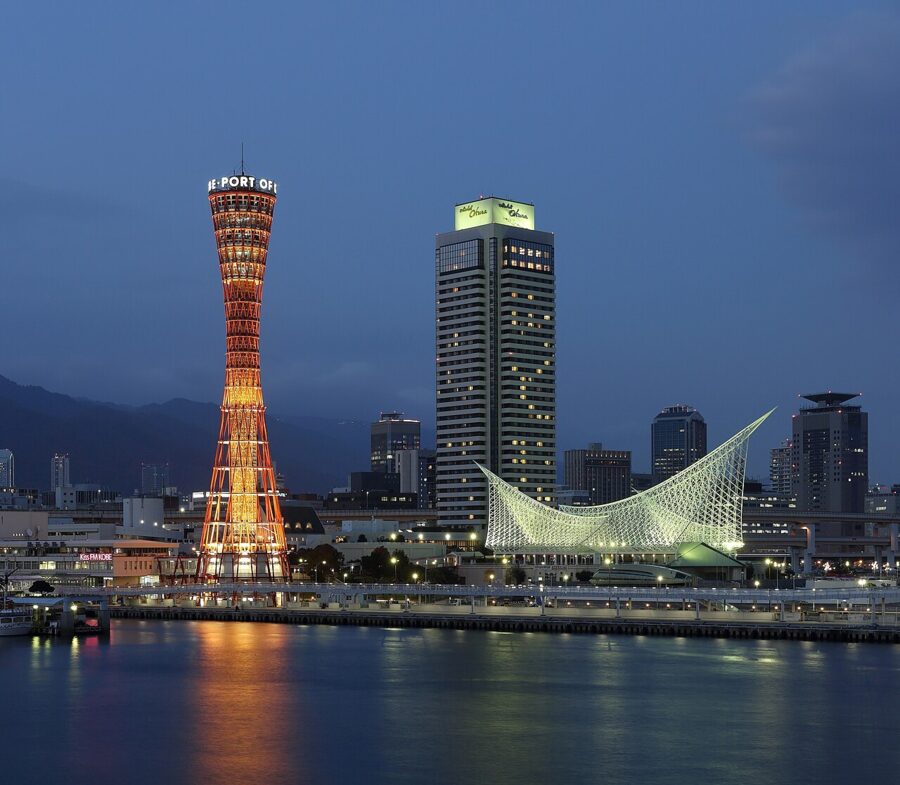
The waterfront you want is Meriken Park, a reclaimed pier between the old harbour and the Harborland shopping quarter. Its landmark is the red lattice of Kobe Port Tower, which reopened in 2024 after a long renovation. The observation floors and rooftop deck are open from 9:00 to 23:00 (last entry 22:30) and cost ¥1,200 (about £6 / $7.50) for adults with the deck or ¥1,000 (about £5 / $6.50) without, on a timed ticket, as of November 2026.

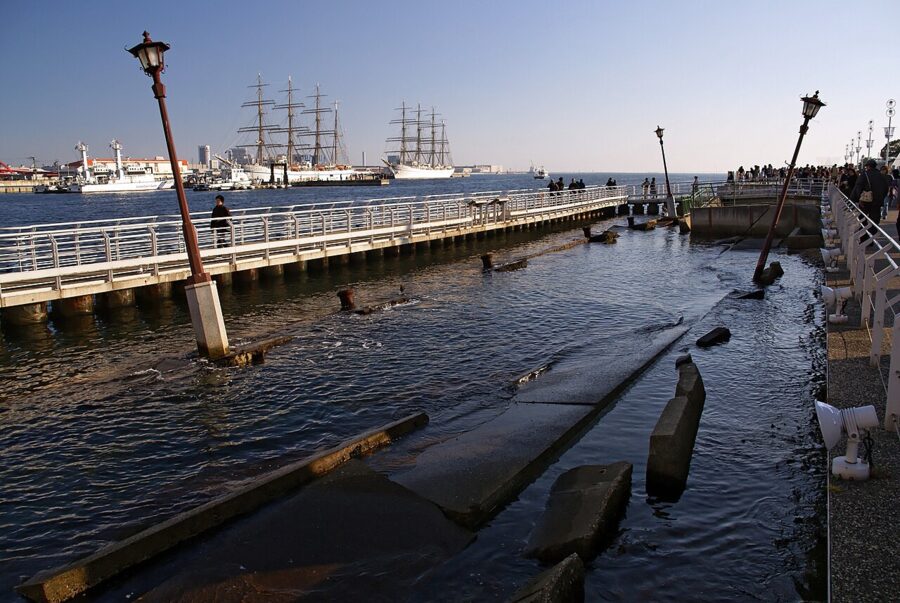
Walk to the east end of the park and the mood changes. A stretch of the quay has been left exactly as the earthquake of 17 January 1995 left it: the paving slumped into the water, the lamp posts lean at odd angles, and the edge of the pier has slid towards the sea. This is the Port of Kobe Earthquake Memorial Park, and it costs nothing to stand there.

1995 and the Disaster Reduction Museum
To understand the earthquake, go to the Disaster Reduction and Human Renovation Institution on the eastern waterfront, twelve minutes on foot from JR Nada Station. Its first exhibit is a seven-minute film, The Shock of 5:46, that puts you inside the collapsing city; after that come the stories of the people who dug neighbours out of the rubble, and the long rebuilding that followed. It is a hard hour, and I would not leave Kobe without it.
The museum opens 9:30 to 17:30 (last entry 16:30) and closes on Mondays, with a winter break from 28 December 2026 to 4 January 2027. Adults pay ¥650 (about £3 / $4), and entry is free on the 17th of every month, the date of the earthquake.

Kitano and the foreign houses
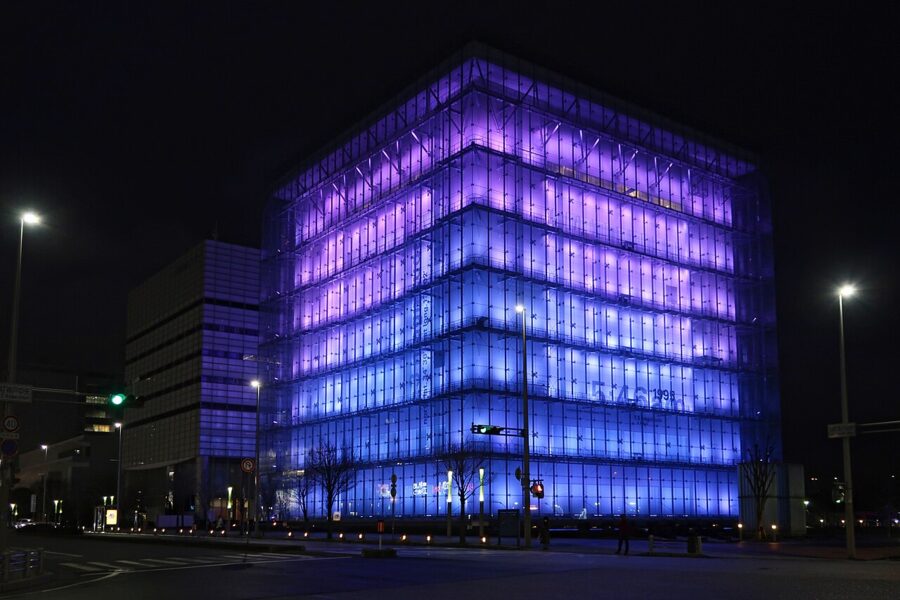
The slope north of Sannomiya is Kitano, where the foreign merchants built their homes once the city had filled up below. Many of these ijinkan, “foreigners’ houses”, survive, some open as museums, others as cafes or wedding halls. The best of them is the Weathercock House, built around 1909 for the German trader Gottfried Thomas by the architect Georg de Lalande and now an Important Cultural Property.
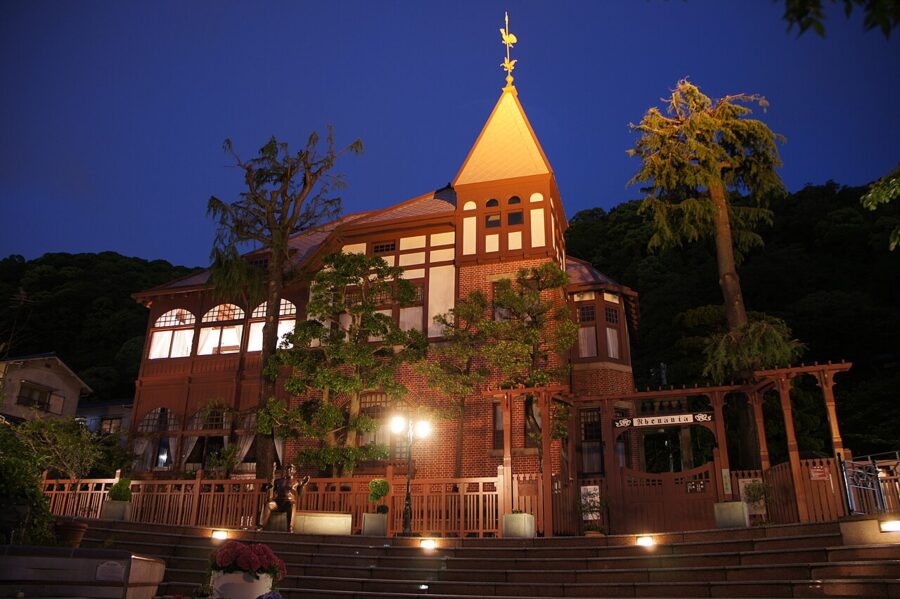

The house is open 9:00 to 17:00 and closes on the third Tuesday of each month; entry is ¥500 (about £2.40 / $3.20), or ¥800 with the green clapboard Moegi House next door, as of November 2026. Most other houses are private ventures with their own tickets; choose two or three, and leave time for the steep, quiet streets with views back down to the harbour.
Nankinmachi
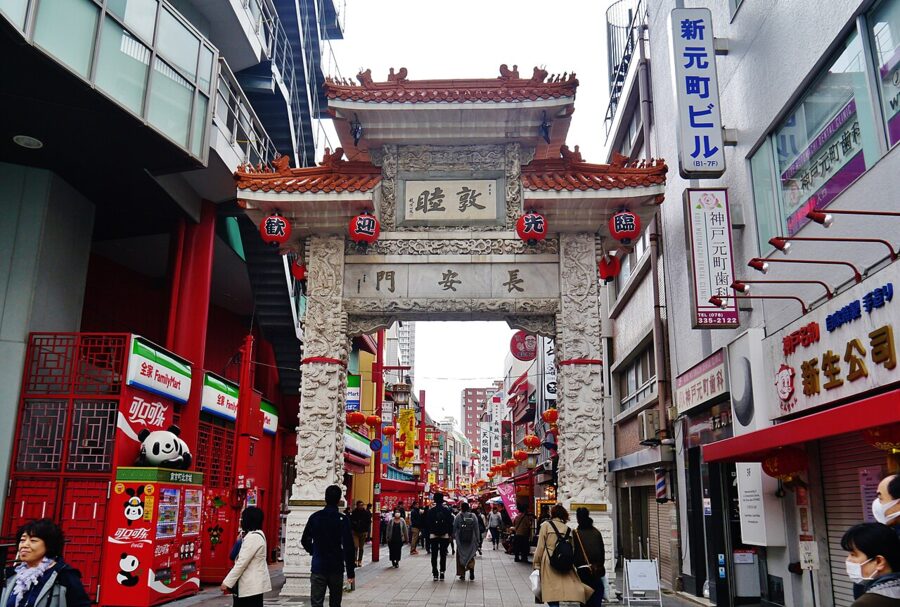
Chinese merchants came to Kobe with the opening of the port, and their quarter, Nankinmachi, is still there between the Motomachi shopping arcade and the old harbour. It is small, a cross of two short streets with gates at the ends, and best at lunchtime, when the stalls sell steamed pork buns and dumplings to people who eat them standing up.

Kobe beef: what the label means
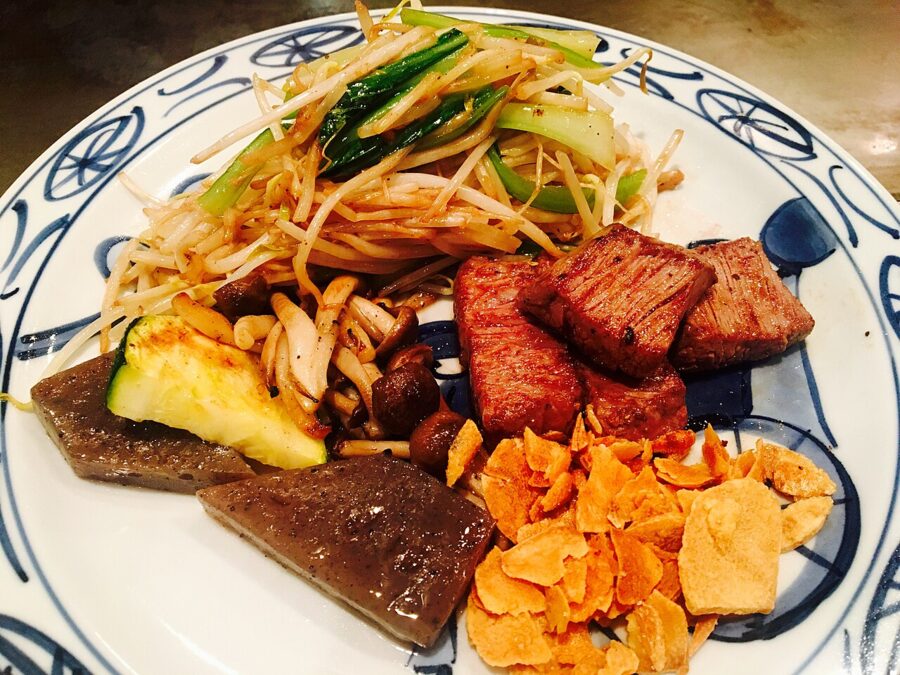
Kobe beef is the most copied food name in Japan, and the rules behind it are strict. According to the Kobe Beef Marketing and Distribution Promotion Association, the animal must be a Tajima-strain black cow born, raised and slaughtered in Hyogo, and it must be a heifer or a steer. The carcass then has to grade A or B for yield, 4 or above for meat quality, and 6 or above on the twelve-point marbling scale, and it must weigh no more than 499.9 kilograms.
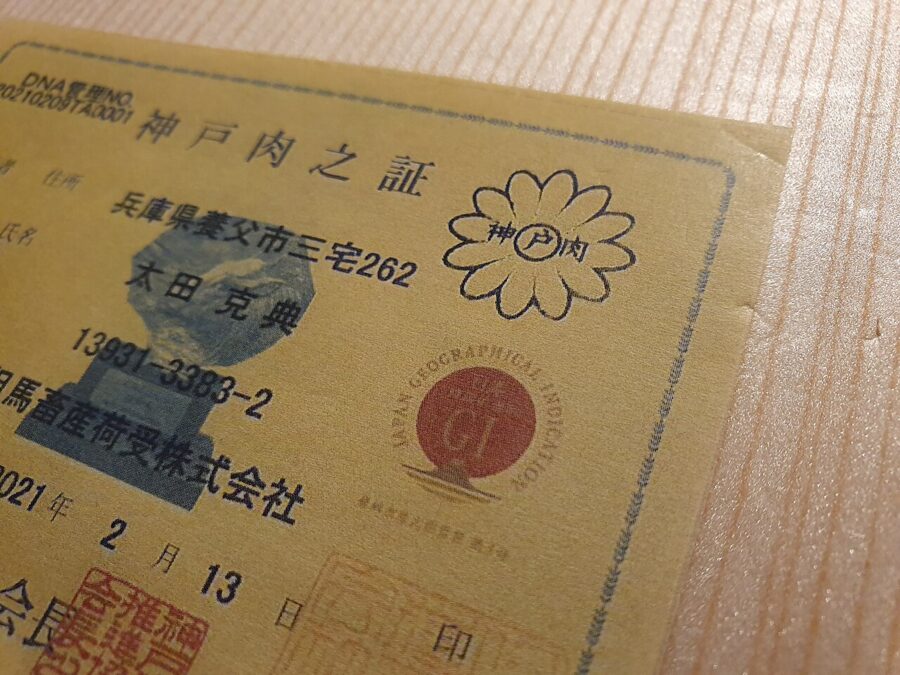
Tajima beef that misses those marks is still sold, often very good, under its own name. The problem is the restaurant that calls any wagyu “Kobe”. In Kobe itself, ask to see the certificate or the animal’s identification number; a genuine steakhouse will have it.
The classic way to eat it is teppanyaki, cooked on a hot iron plate in front of you, and the cheapest way is a set lunch. Prices vary widely by cut and weight, so check the menu before you sit down.

Nada: the sake coast
East of the city centre, along the shore between Kobe and Nishinomiya, is the Nada district, Japan’s largest sake-brewing area. It grew on three things it had in quantity: rice from the Harima plain, hard spring water called miyamizu, and cold winds off Mount Rokko for the winter brewing season. Several brewers run free museums.
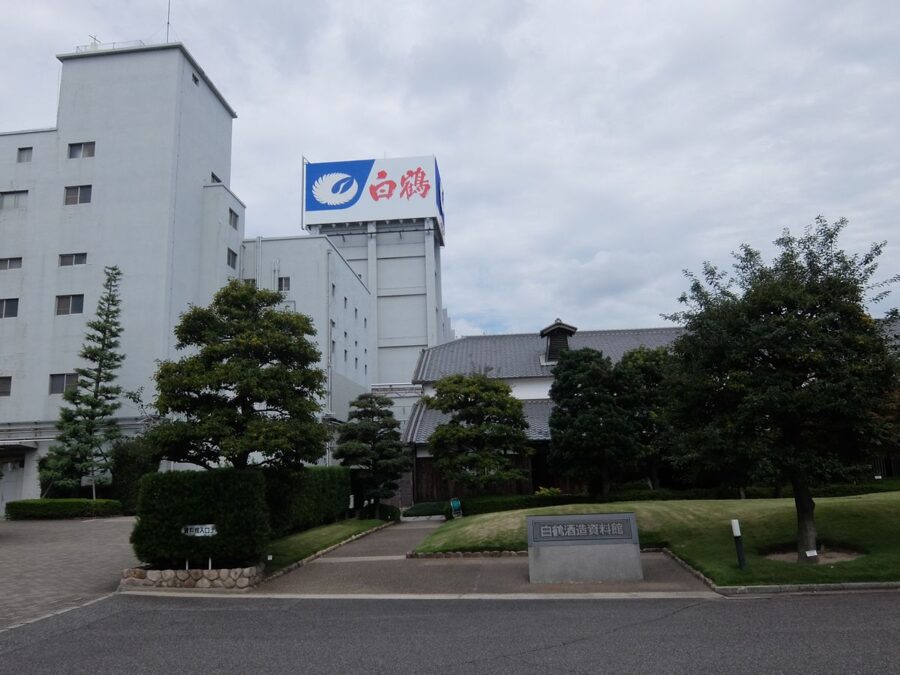

The Hakutsuru Sake Brewery Museum is the easiest to reach and the most complete, open 9:30 to 16:30 with free entry as of November 2026. Its life-size models of the old tubs, presses and brewers explain a trade most drinkers never see.
Mount Rokko and Mount Maya
The wall of mountains behind Kobe rises to 931 metres at Mount Rokko, and the city’s evening ritual is to go up and look down. The Rokko Cable climbs 1.7 kilometres from Rokko Cable-shita station to 737 metres in about ten minutes; buses link the upper station to the viewpoints, a garden terrace and the ropeway station. Further west, the Maya cable car and ropeway lead to Kikuseidai on Mount Maya, the other classic night view.
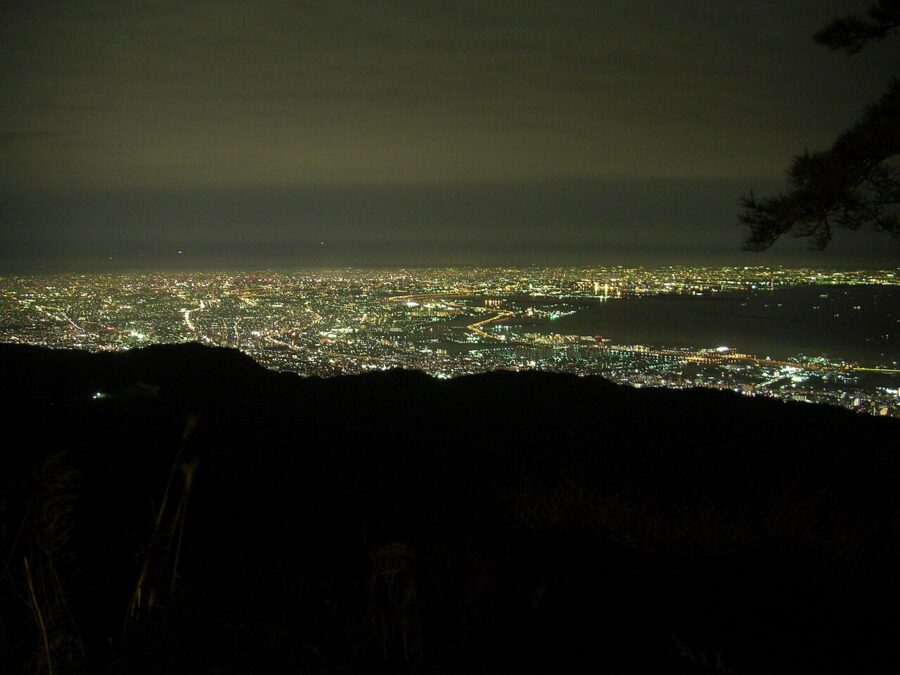

The Rokko-Arima Ropeway runs from the summit area down the north face to Arima Onsen in about twelve minutes, with cars every twenty minutes, and it was operating normally as of November 2026. The best use of the mountain is to cross it: up by cable car in the afternoon, down by ropeway, a bath at Arima and the train back after dinner.
Arima Onsen
Arima is a hot spring town of steep lanes in a valley on the north side of Rokko, technically inside Kobe city but a world away from the harbour. It appears in the oldest Japanese chronicles and was a favourite of Toyotomi Hideyoshi, who rebuilt its baths in the sixteenth century. Its claim is two very different waters from one small town.
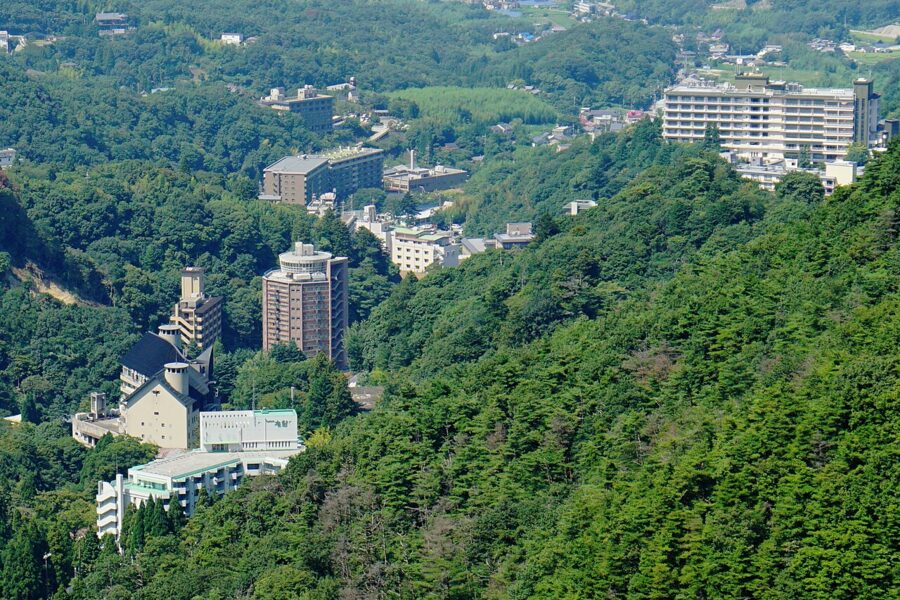

Kinsen, the “gold spring”, comes out of the ground iron-rich and salty and turns rust-brown in the air. Ginsen, the “silver spring”, is clear and carries carbonic acid and radon. Both are available to day visitors at two public bathhouses run by the town, and the times and prices below are as of November 2026.
- Kin no Yu (gold water): 8:00 to 22:00, last entry 21:30; adults ¥800 (about £4 / $5), ¥650 on weekdays; closed the second and fourth Tuesdays.
- Gin no Yu (silver water): 9:00 to 21:00, last entry 20:30; adults ¥700 (about £3.40 / $4.50), ¥550 (about £2.70 / $3.50) on weekdays; closed the first and third Tuesdays.
- A ticket for both bathhouses costs ¥1,200.
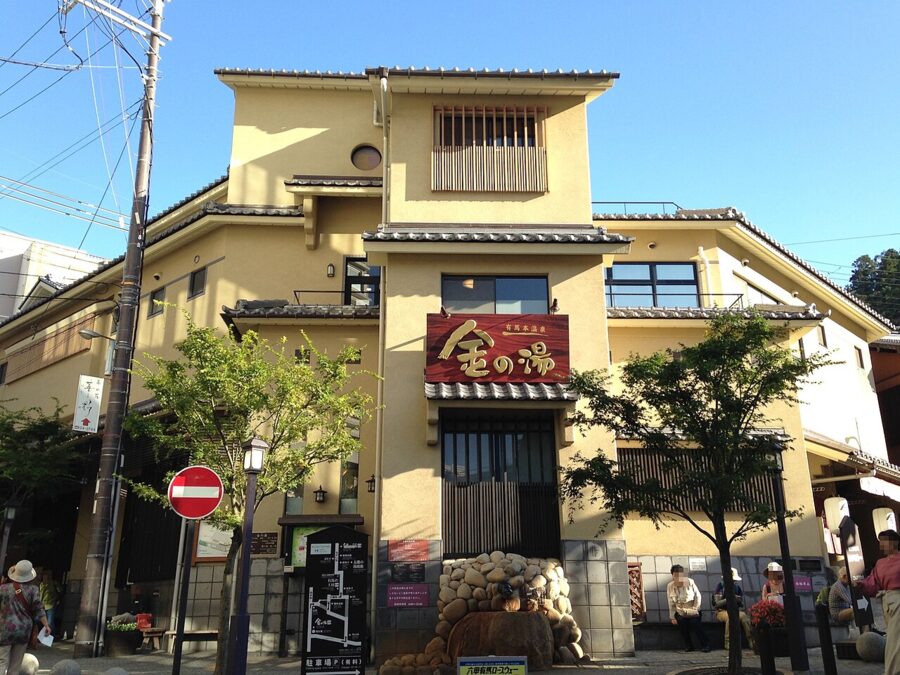

Arima works as an evening from Kobe, or a night in a ryokan. From Shin-Kobe, the Hokushin Kyuko line tunnels under the mountain to Tanigami, where you change to the Kobe Electric Railway for Arima-Onsen Station.
Himeji Castle and the Harima plain
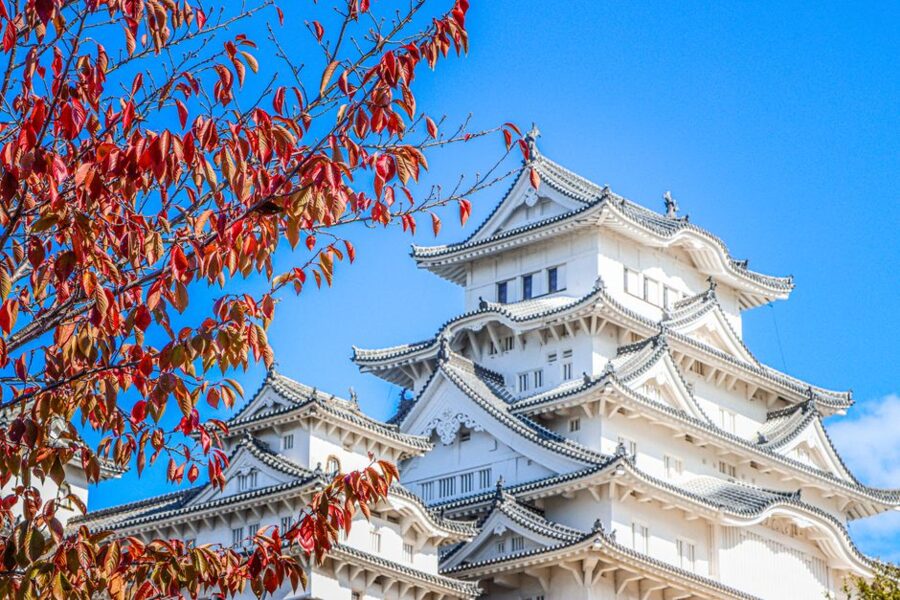
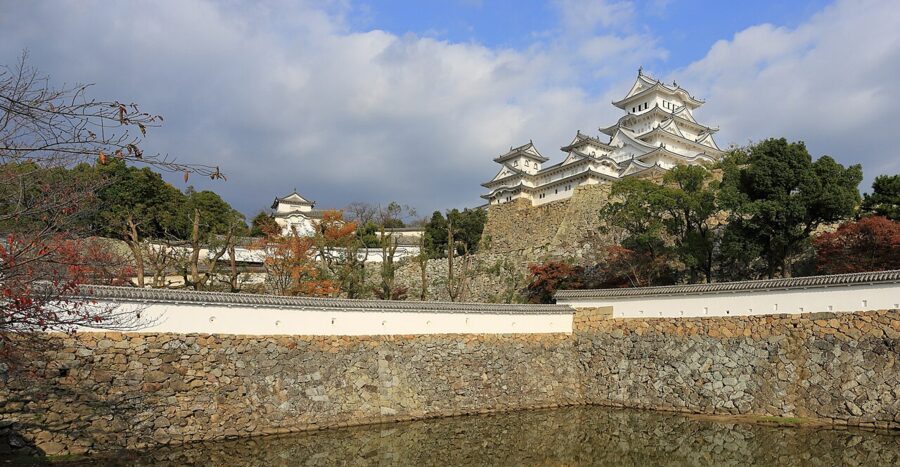
Himeji Castle stands on a low hill in the middle of a flat city, which is why you see it from the train long before you arrive. The castle that survives was completed in 1609 for Ikeda Terumasa, son-in-law of Tokugawa Ieyasu, and it has come through four centuries of fire, civil war and the American bombing of Himeji in 1945 without losing its main buildings. In 1993 it became one of Japan’s first two UNESCO World Heritage Sites, together with Horyu-ji near Nara.

The keep, the queue and the fees
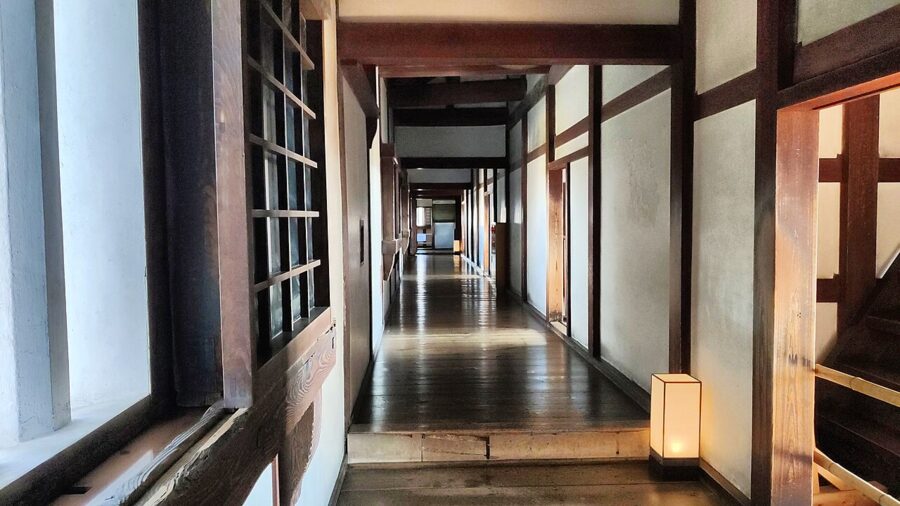
The route to the keep is a deliberately confusing spiral of gates and narrowing passages, built to trap attackers under fire. Inside, the main keep is five storeys outside and six floors plus a basement within, connected by stairs so steep and narrow that you climb them almost like ladders. Shoes come off at the door, and the castle office asks you to bring a bag for them and warm socks for the wooden floors.
As of November 2026 the castle opens 9:00 to 17:00, last entry 16:00, every day except 29 and 30 December. Adults aged 18 and over pay ¥2,500 (about £12 / $16), with a reduced rate of ¥1,000 for Himeji residents; under-18s go free. A combined ticket with Koko-en garden costs ¥2,600 (about £13 / $17), which makes the garden nearly free.
The queue is the thing to plan around. On spring and autumn weekends the wait to climb the keep can be long, and the castle website shows the live times to the ticket office and to the keep entrance. Arrive at 9:00, go straight to the keep, and see the West Bailey afterwards.
Koko-en
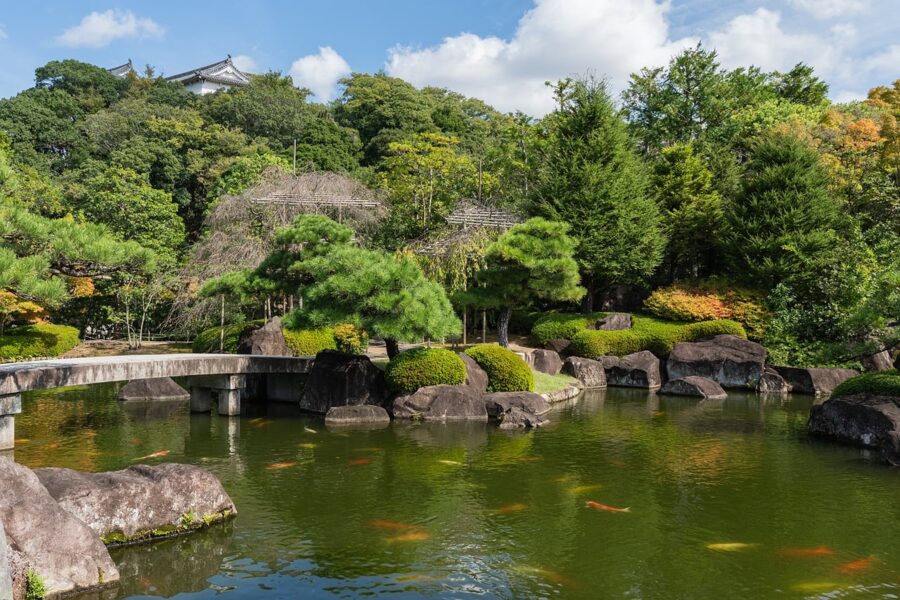
Just west of the castle moat, on the site of the lord’s western residences, Koko-en is a modern garden of nine walled sections built in the traditional manner, with a pond garden, a tea garden and a bamboo garden among them. It opens 9:00 to 17:00 (entry until 16:30), and the adult ticket is ¥400 (about £2 / $2.50) on its own.
Mount Shosha
Himeji’s second sight is under half an hour from the castle by bus and far less visited. Engyo-ji, a Tendai temple founded in the tenth century on Mount Shosha, is called the Hiei of the West, after the great monastery above Kyoto. Its halls stand among cedars along the ridge, and its three great wooden halls were used for scenes in the film The Last Samurai.
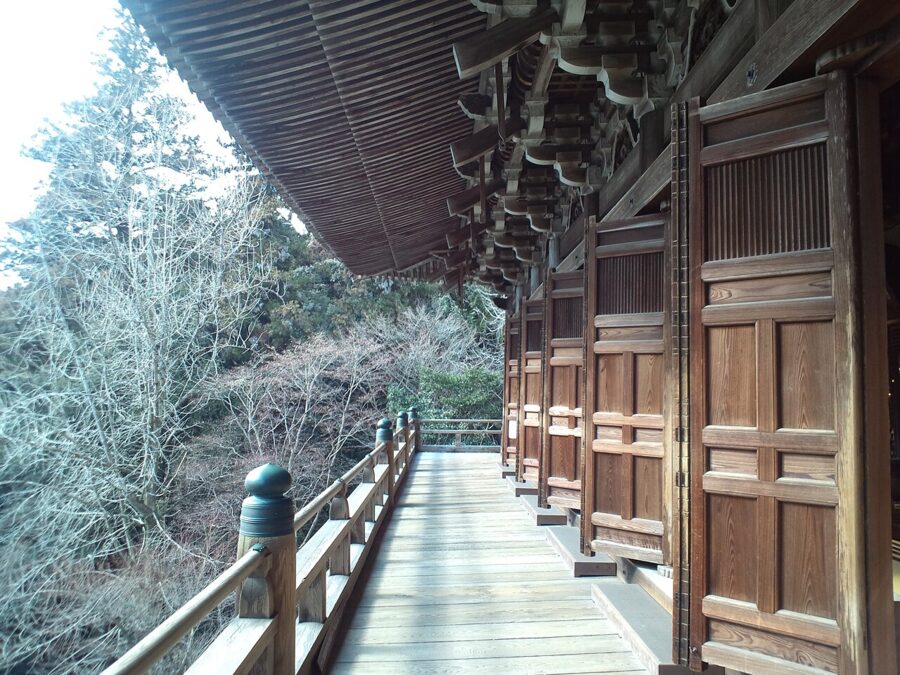

Take Shinki bus 10 from Himeji Station (29 minutes, ¥320, about £1.60 / $2) to the foot of the Mount Shosha Ropeway, which rises in four minutes with departures every quarter hour from 8:30. Fares are ¥700 one way or ¥1,200 return (about £6 / $7.50), and the temple charges its own entry at the top. Allow two hours on the mountain. Note that the ropeway will close for a major refit from 5 February to 28 October 2027; in that period the only way up is the hiking trail.

Takeda Castle ruins: the castle above the clouds
Sixty kilometres north of Himeji, up the Bantan line, a ridge 353 metres high above the town of Takeda carries the stone walls of a castle that no longer exists. Takeda Castle was a mountain stronghold of the Tajima region, rebuilt in stone in the late sixteenth century and abandoned soon after 1600. Its walls survive almost complete, laid in the dry-stone style of the period, and they follow the crest of the ridge for several hundred metres.
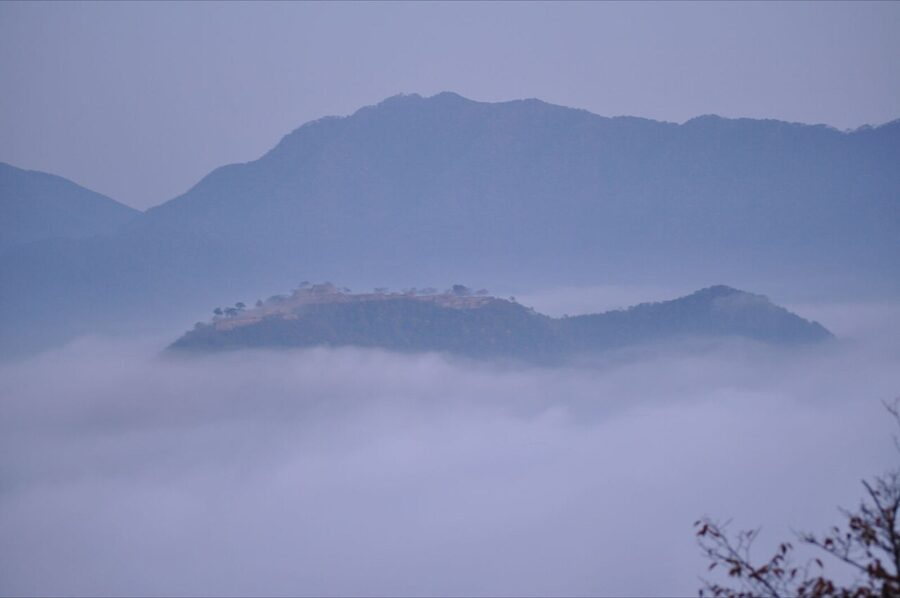

The famous photograph needs luck and an early start. Cloud forms most often between September and early December, on clear mornings after a cold night, and usually burns off by mid-morning.
The grounds open at 5:00 in this season; for 2026 the early openings run until 6 December, after which winter hours are 10:00 to 15:00. The ruins close completely from 4 January to the end of February. Entry is ¥500 (about £2.40 / $3.20) for adults.
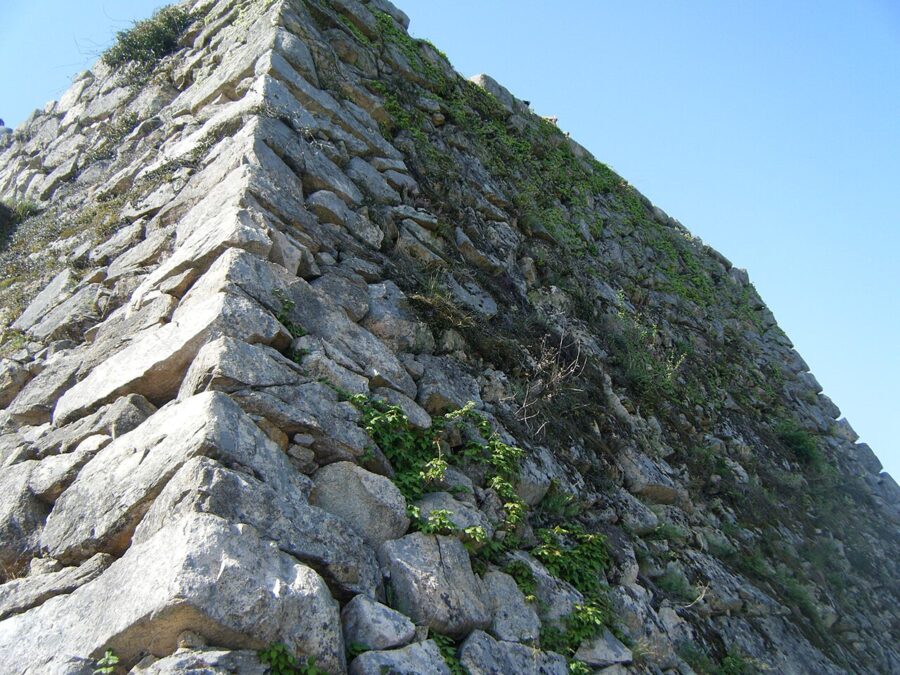
Getting up is a walk whichever way you choose. From the Yamashiro no Sato visitor centre, where the shop and restaurant reopened on 18 November 2026, the paved west path takes about 40 minutes. As of October 2026 the city had closed the steep trail behind Takeda Station and the Omote-Yone shrine trail after bear sightings in the area, so check the Asago city notices before you go. The daytime Tenku bus from the station stops running for the winter on 1 December.
Weekend dawns in October and November fill the car parks before the trail gate opens at 4:30, so pick a weekday, sleep in Takeda or Wadayama, and consider a hire car.
Kinosaki Onsen
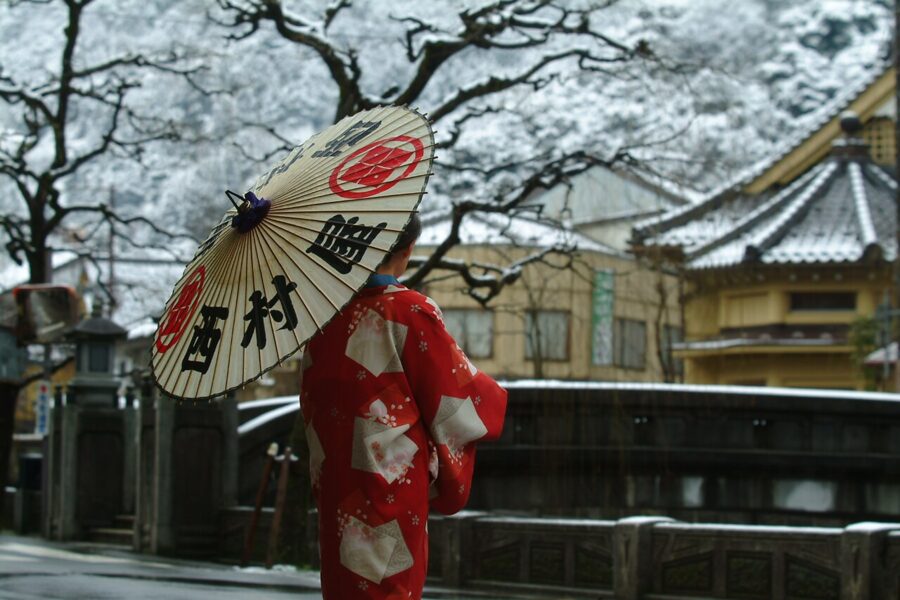
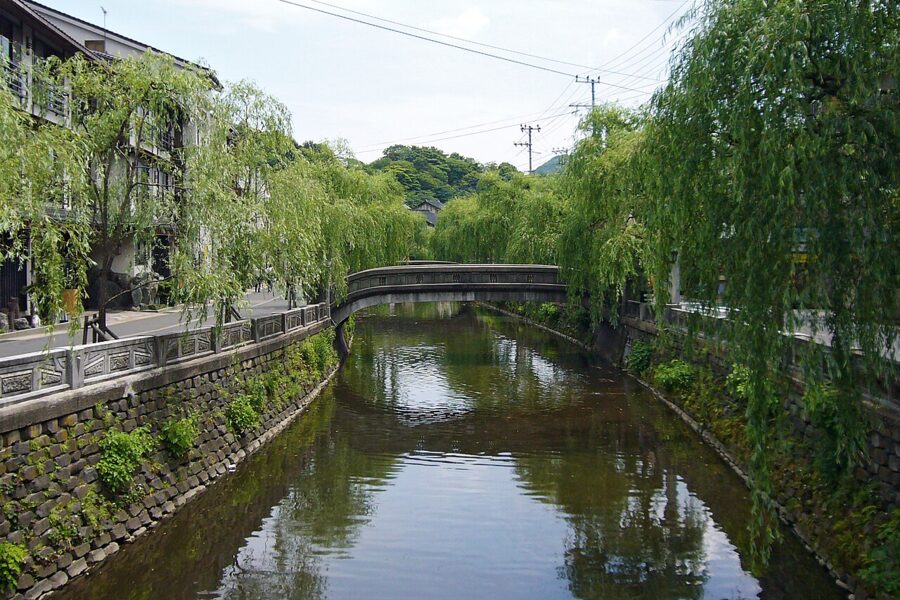
Kinosaki is a small spa town a few kilometres inland from the Sea of Japan, built along a willow-lined river with stone bridges. Its waters have been used for some 1,300 years, and the town was rebuilt after an earthquake in 1925 in the style it keeps today: two- and three-storey wooden inns, low roofs and public bathhouses at intervals along the river. The writer Shiga Naoya stayed here in 1913 and made it famous in the story “At Kinosaki”.

The public baths
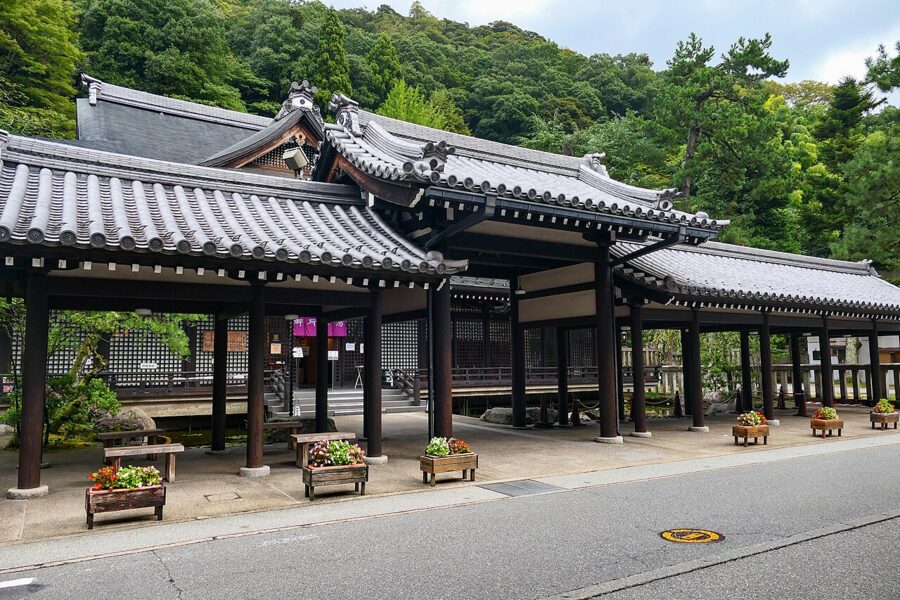
Kinosaki’s custom is sotoyu meguri: you stay at an inn but bathe around the town, walking from one public bathhouse to the next. There are seven bathhouses in the tradition, but as of November 2026 only six are open. Satono-yu by the station has been closed indefinitely since April 2024, while Kono-yu reopened on 28 October 2026 after a long refit. The town’s bathing guide lists the hours and live crowd levels.
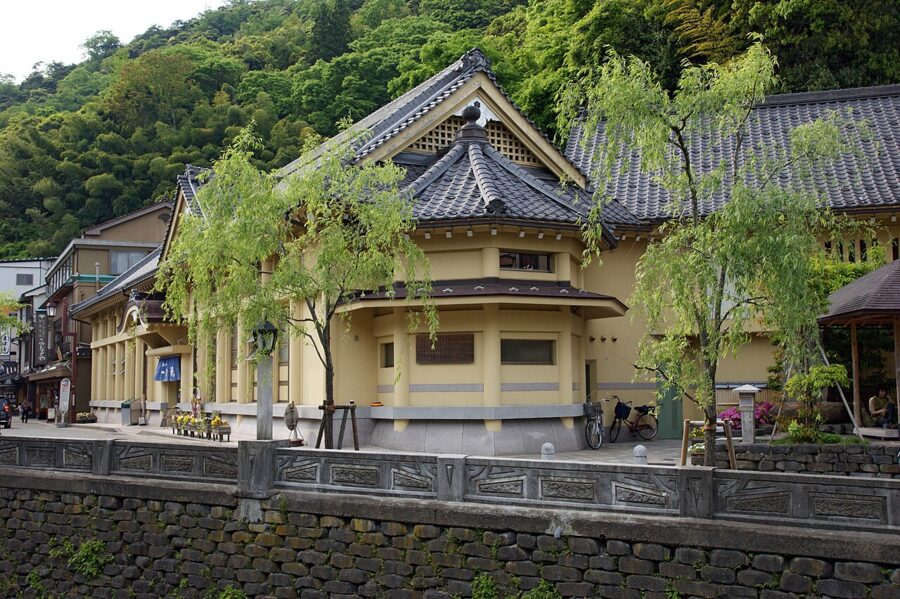

- Ichi no Yu, Goshono-yu, Jizo-yu and Kono-yu open 7:00 to 23:00.
- Mandara-yu and Yanagi-yu open 15:00 to 23:00.
- Each bathhouse closes one day a week, on different days, so several are always open.
A single bath costs ¥800 (about £4 / $5) for adults. The Yumepa day pass for all of them costs ¥1,500 (about £7 / $9.50), and most inns hand their guests a pass at check-in. Every bathhouse in Kinosaki admits people with tattoos, which is still unusual in Japan.
The yukata walk
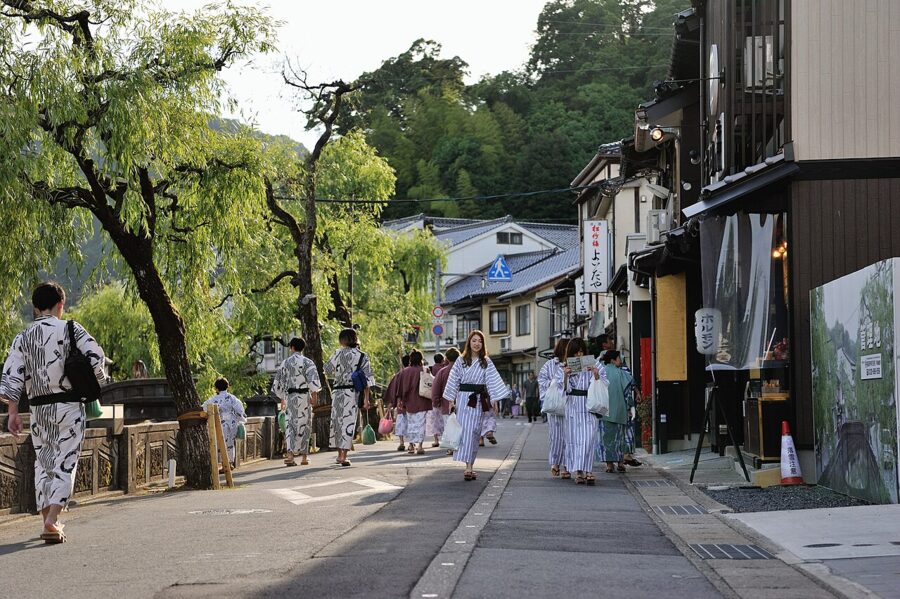
The other half of the ritual is walking between baths in the cotton yukata and wooden geta that every inn provides. After about four in the afternoon the streets fill with guests in patterned robes, clacking over the bridges with a small basket each. It feels like dressing up for about five minutes, and after that it is simply the comfortable way to get around.

Crab season
From 6 November to 20 March the boats from the Tajima ports land Matsuba crab, the local name for male snow crab, and the inns of Kinosaki build winter around it. A crab dinner at an inn, boiled, grilled, raw and finished in a rice porridge, is the main reason many Japanese visitors come between December and February. The female seko crab, smaller and full of roe, is landed only until the end of December.
Crab plans cost far more and the best inns fill weeks ahead. Outside the season, inn dinners turn to Tajima beef at gentler prices.
Izushi and Genbudo
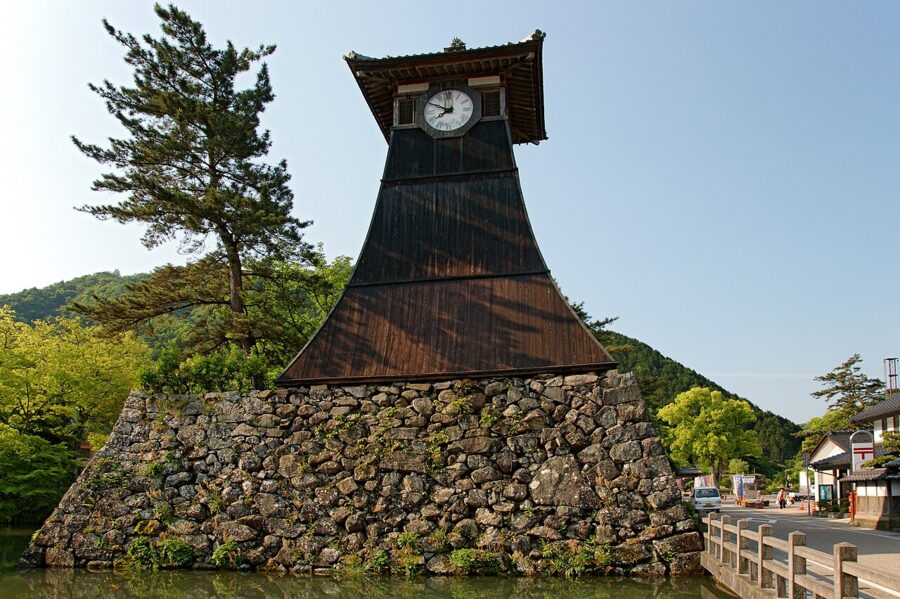
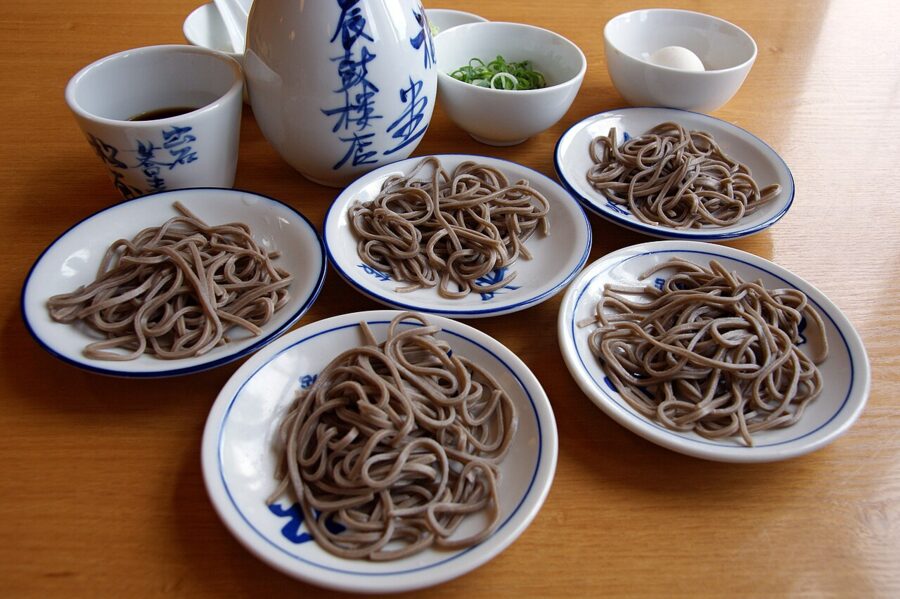
Two short trips from Kinosaki are worth a half day each. Izushi, a former castle town a bus ride south of Toyooka, has a grid of old merchant streets, a Meiji-era clock tower called the Shinkoro and a dish all its own.


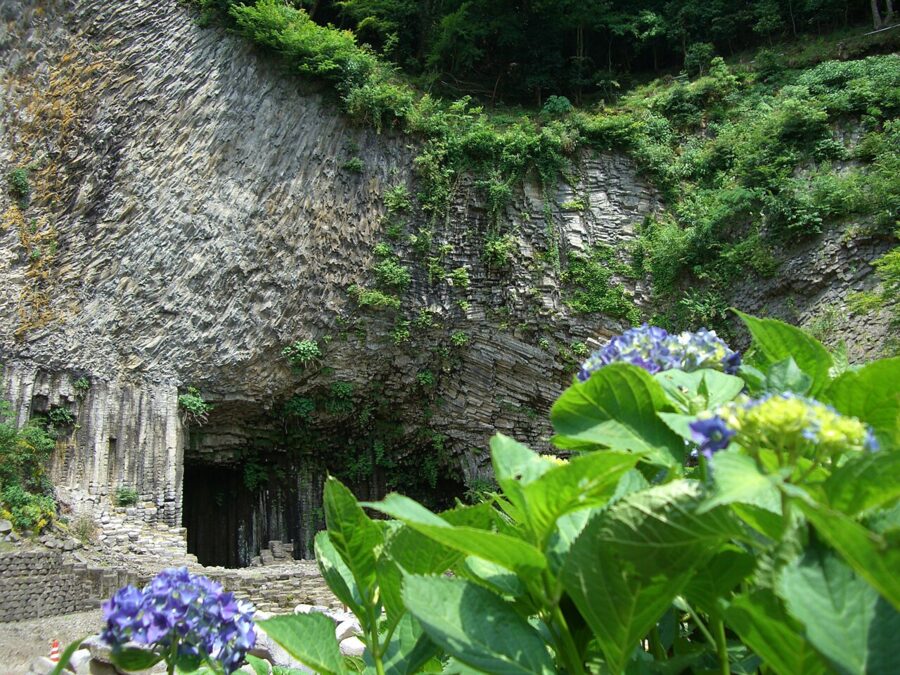
Closer to Kinosaki, one stop south on the San’in line, is Genbudo, a cliff of hexagonal basalt columns formed by lava 1.6 million years ago. The rock here showed the geophysicist Matuyama Motonori in 1929 that the earth’s magnetic field had once pointed the other way, and the San’in Kaigan Geopark around it runs west along the coast towards Tottori.

Trains reach Kinosaki Onsen from Kyoto in about 2 hours 20 minutes on the Kinosaki limited express, from Osaka in about 2 hours 40 minutes on the Konotori, and from Sannomiya in Kobe in about 2 hours 30 minutes on the Hamakaze, which also calls at Himeji. All of these limited expresses expect a reserved seat, so book one. The spa association’s access page also lists direct buses from Osaka and Kobe, which take longer.
Akashi, the bridge and Awaji Island
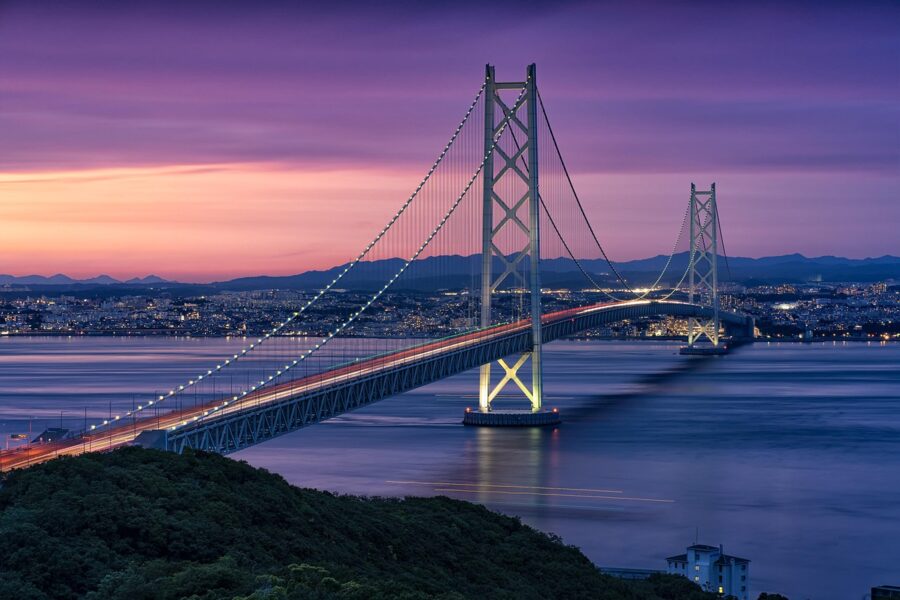
West of Kobe the coast pinches in to the Akashi Strait, four kilometres of fast tidal water between Honshu and Awaji Island. The Akashi Kaikyo Bridge crosses it: 3,911 metres long, with a central span of 1,991 metres between towers that stand nearly 300 metres above the sea. When it opened in 1998 it was the longest suspension span in the world, and it held that title until Turkey’s Canakkale bridge opened in 2022.
The 1995 earthquake had its epicentre right here, when the two towers were up and the main cables were being strung. The ground under the towers moved, the gap between them grew, and the builders adjusted the deck panels they had not yet made to fit the new length.
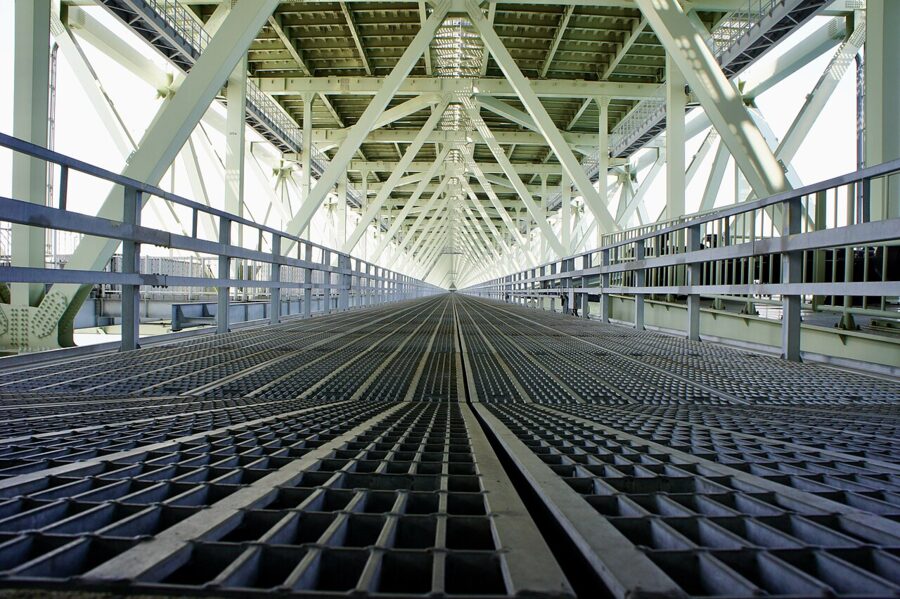

The Bridge World tour runs on set days from April to November 2026 and again in March 2027, in morning and afternoon groups of up to 48. It lasts about two hours and fifty minutes, must be booked and paid online in advance, and is open to those aged 12 and over. The ticket includes the bridge exhibition centre and the Maiko Marine Promenade, a glass-floored walkway under the deck at the Kobe end.
Akashi itself, a few minutes west of the bridge by JR, is a fishing town known for octopus and sea bream. Its own dish is akashiyaki, soft egg-rich dumplings with octopus inside, which you dip in warm dashi broth rather than eat with sauce.
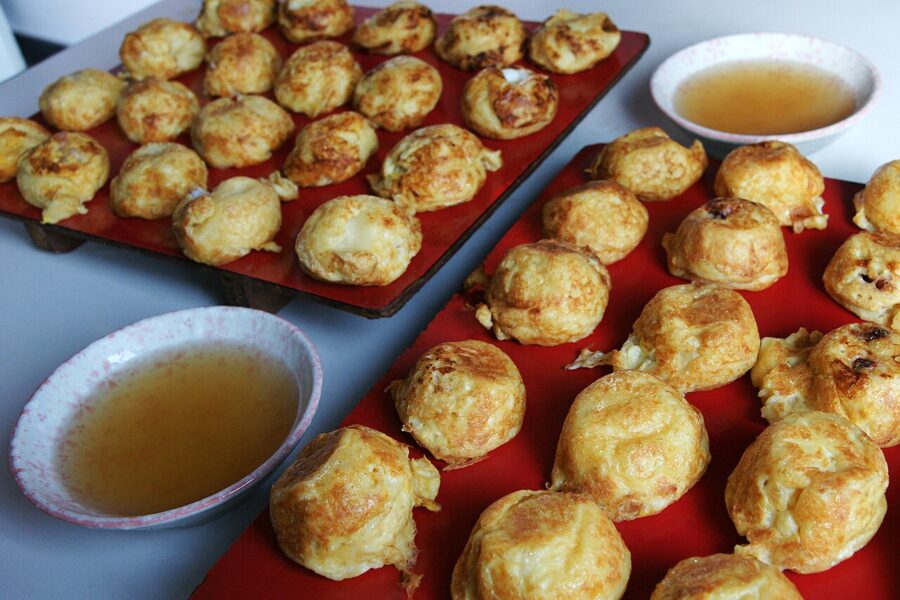

Awaji Island
Awaji is the largest island in the Inland Sea, about 50 kilometres long, with farmland, fishing harbours and beaches facing both ways. In the Kojiki, Japan’s oldest chronicle, it was the first land the gods Izanagi and Izanami created, and Izanagi Jingu in the north of the island marks the place where Izanagi is said to have spent his final days.
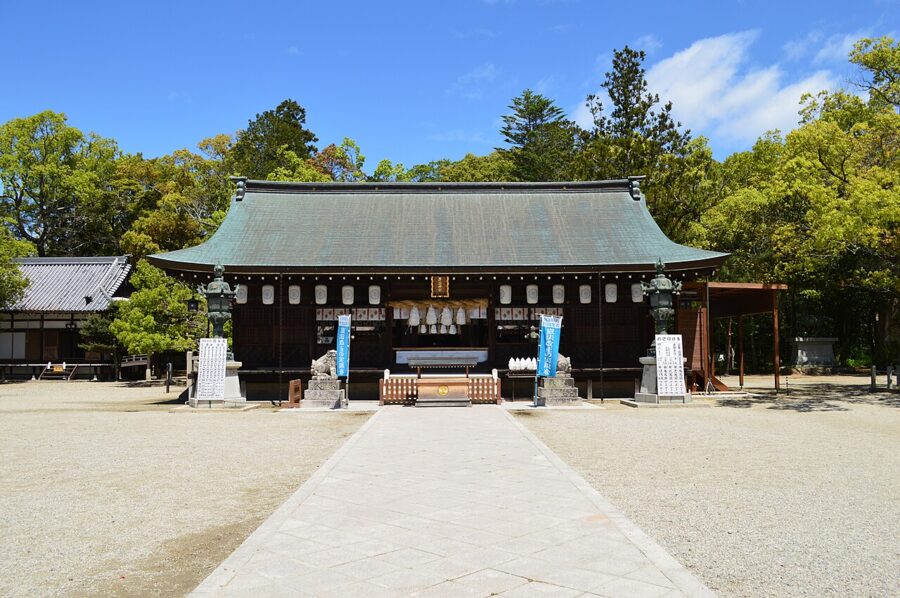
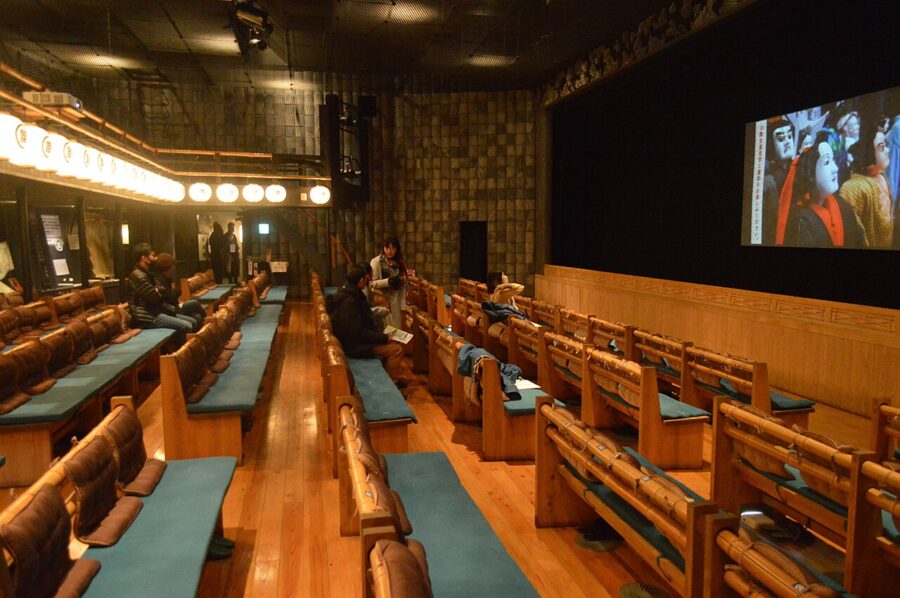
The island’s own art is puppet theatre. Awaji ningyo joruri, with large puppets worked by three handlers each, is more than 500 years old and is still performed daily at the Awaji Ningyoza in the port of Fukura. Shows begin at 10:00, 11:10, 13:30 and 15:00, the theatre closes on Wednesdays, and adult tickets cost ¥1,800 (about £9 / $11.50) as of November 2026.

Fukura is also where sightseeing boats leave for the Naruto whirlpools, which form under the Onaruto Bridge between Awaji and Shikoku when the tide runs hard through the strait. They are strongest around the spring tides, so check a tide table before you go. Across that bridge lies Shikoku.
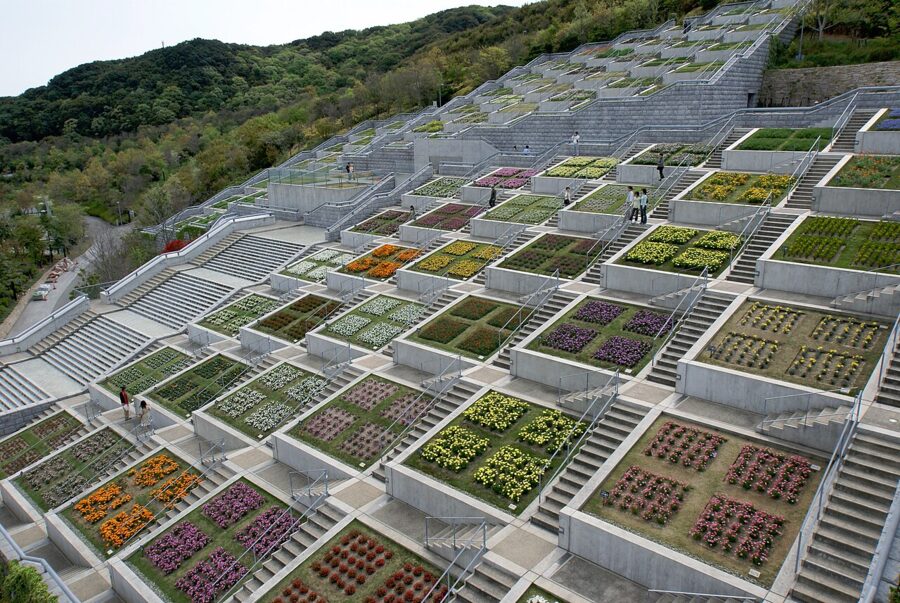

Awaji is a place to drive. Highway buses from Sannomiya and Maiko cross the bridge to the main towns, and the small fast boats of the Awaji Jenova Line run between Akashi port and Iwaya at the northern tip. To string together Izanagi Jingu, Yumebutai, Fukura and the flower parks in a day, though, you need a car.
Getting there and getting around
Kobe and Himeji both sit on the Sanyo Shinkansen, the western half of the bullet-train line from Tokyo. Shin-Kobe is under three hours from Tokyo by Nozomi, and Himeji is 30 minutes from Shin-Osaka. Going west, Himeji is about 20 minutes from Okayama, and the same trains continue to Hiroshima.
Along the coast, JR special rapid trains link Osaka, Sannomiya and Himeji, and the private Hanshin and Sanyo railways run parallel, stopping near the sake breweries and in Akashi. Kobe Airport, on an island in the harbour, has mainly domestic flights, and Kansai International is a ferry ride or a long train trip away; the flights page covers the airports.
The north is where planning matters. Limited expresses to Kinosaki run far less often than city trains, and the Bantan line through Takeda is mostly slow local service. A circuit that works by rail runs Kobe, Himeji, then north up the Bantan line to Takeda and Wadayama, on to Kinosaki, and back to Kyoto or Osaka. The map of Japan shows how that loop sits within Kansai.
| Route | Service | Time |
|---|---|---|
| Shin-Osaka to Himeji | Sanyo Shinkansen | About 30 min |
| Osaka to Sannomiya | JR special rapid | About 20 min |
| Osaka to Himeji | JR special rapid | About 1 hr |
| Kyoto to Kinosaki Onsen | Limited express Kinosaki | About 2 hr 20 min |
| Osaka to Kinosaki Onsen | Limited express Konotori | About 2 hr 40 min |
| Sannomiya to Kinosaki Onsen | Limited express Hamakaze | About 2 hr 30 min |
| Himeji Station to Mount Shosha Ropeway | Shinki bus 10 | 29 min |
For money, cards and connectivity, the practical information page applies here as everywhere. Hyogo’s cities take IC cards on trains and buses; the mountain ropeways, the Takeda bus and some Kinosaki shops are happier with cash.
How many days, and in what order
Three days covers the south from one hotel in Kobe: a day for the harbour, Kitano and the earthquake museum, one for Himeji Castle and Mount Shosha, and one for Mount Rokko and the baths at Arima.
Five days adds the north. Go up the Bantan line from Himeji in the afternoon, sleep near Takeda, walk to the ruins at dawn, and carry on to Kinosaki for a night of baths and an inn dinner. From Kinosaki the trains run straight back to Kyoto or Osaka, so the trip makes a loop rather than a dead end.
A sixth day, with a car, is for Awaji: the bridge from Maiko, Yumebutai, Izanagi Jingu, a puppet play at Fukura and the whirlpools on the afternoon tide. From the southern tip of Awaji, the road continues over the Onaruto Bridge into Tokushima, and Hyogo becomes the gateway to Shikoku rather than the end of the trip.
If you have only one day and you are already in Osaka or Kyoto, go to Himeji early, climb the keep first, and take the train back through Kobe for an evening in Kitano and a teppanyaki dinner. Then come back in winter for the other coast, where the snow falls on Kinosaki and the crab boats are out.